Pace & Data
What vVO2max for a 3, 3:30, 4 or 4:30 Marathon? The Reference Table
Are you aiming for a 3h, 3h30, 4h, or 4h30 marathon and wondering whether your current VMA is sufficient? VMA is one of the strongest predictors of marathon performance. If it is not at the required level, your target time may be physiologically unrealistic, regardless of your motivation. In this article, we explain the VMA required for each marathon goal, how to determine whether your target is realistic, and the training strategies that can help you maximize your chances of success.
StrideMatch TeamAugust 11, 20267 min Reading time
VMA and Marathon Goals: Is Your VMA High Enough?
Are you aiming for a 3h, 3h30, 4h, or 4h30 marathon and wondering whether your current VMA is sufficient?
VMA is one of the best predictors of marathon performance. If it is not at the right level, your target time may be physiologically unrealistic, regardless of your motivation.
In this article, we explain:
- the minimum VMA required for each marathon goal;
- how to test your VMA;
- how to develop it if it is not yet at the required level.
Why VMA Determines Your Marathon Performance
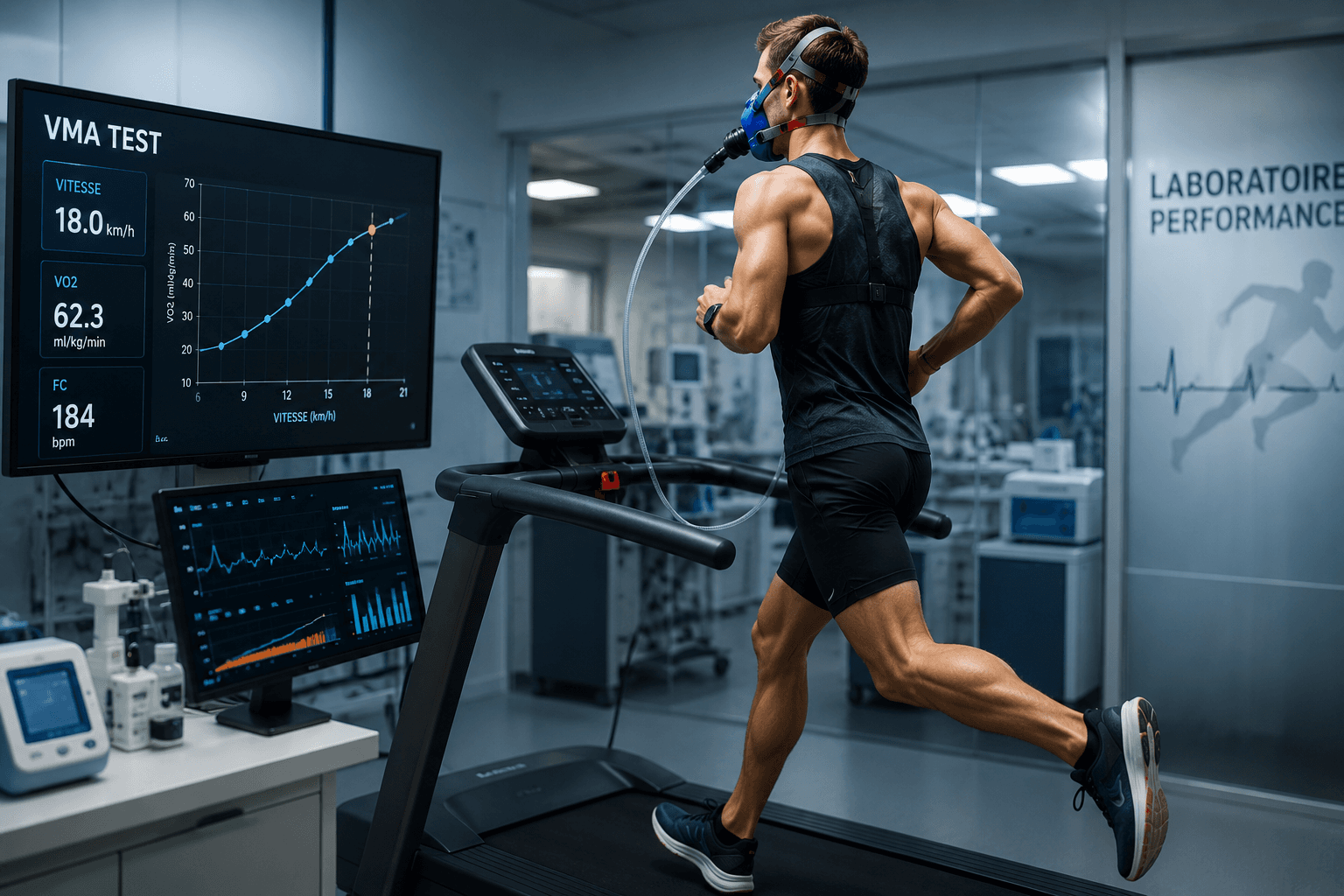
Your VMA (Maximum Aerobic Speed) represents the minimum speed at which your body reaches its maximum oxygen consumption.
It is your physiological ceiling.
During a marathon, you generally run at around 75–85% of your VMA, depending on your endurance level.
- A highly endurance-trained runner can maintain around 85% of their VMA during a marathon.
- A runner with less developed endurance will usually be closer to 75–80%.
Your VMA therefore defines part of the range of marathon times you can realistically achieve.
Without sufficient VMA, some marathon goals can become extremely difficult to reach, even with a well-structured training plan.
VMA Requirements by Marathon Goal
The following ranges correspond to well-prepared runners following a structured training plan of 16 weeks or more.
🏃 Sub-5-Hour Marathon
- Target pace: 7'06/km
- Minimum VMA: 11 km/h
- Optimal VMA: 12–12.5 km/h
- Race intensity: 73–77% of VMA
🏃 Sub-4:30 Marathon
- Target pace: 6'24/km
- Minimum VMA: 12.5 km/h
- Optimal VMA: 13–13.5 km/h
- Race intensity: 75–78% of VMA
🏃 Sub-4-Hour Marathon
- Target pace: 5'41/km
- Minimum VMA: 14 km/h
- Optimal VMA: 14.5–15 km/h
- Race intensity: 76–80% of VMA
🏃 Sub-3:45 Marathon
- Target pace: 5'20/km
- Minimum VMA: 14.5 km/h
- Optimal VMA: 15–15.5 km/h
- Race intensity: 78–80% of VMA
🏃 Sub-3:30 Marathon
- Target pace: 4'58/km
- Minimum VMA: 15.5 km/h
- Optimal VMA: 16–16.5 km/h
- Race intensity: 79–81% of VMA
🏃 Sub-3:15 Marathon
- Target pace: 4'37/km
- Minimum VMA: 16.5 km/h
- Optimal VMA: 17–17.5 km/h
- Race intensity: 80–82% of VMA
🏃 Sub-3-Hour Marathon
- Target pace: 4'15/km
- Minimum VMA: 17.5 km/h
- Optimal VMA: 18–19 km/h
- Race intensity: 81–83% of VMA
🏃 Sub-2:45 Marathon
- Target pace: 3'54/km
- Minimum VMA: 19 km/h
- Optimal VMA: 19.5–20 km/h
- Race intensity: 83–85% of VMA
How to Interpret These Values
Minimum VMA This represents the threshold below which your target marathon time becomes physiologically difficult to achieve.
Optimal VMA This gives you more margin and allows you to target your goal without having to use every bit of your physiological capacity.
How to Test Your VMA
Several field tests can help estimate your Maximum Aerobic Speed.
1. Half-Cooper Test
The simplest method.
On a track or measured course:
- Warm up for 15–20 minutes.
- Run for exactly 6 minutes.
- Maintain the fastest pace you can sustain for the full six minutes.
- Record the total distance covered.
Formula
VMA (km/h) = (distance in meters ÷ 6) × 0.06
Example
You cover 1,500 meters in 6 minutes.
The calculation is:
VMA = (1500 ÷ 6) × 0.06
Result:
Estimated VMA: 15 km/h
2. VAMEVAL Test
The VAMEVAL test is a progressive running test performed on a track using audio signals.
Your running speed gradually increases until you can no longer maintain the required pace.
Advantage:
- provides a more precise estimate.
Limitations:
- requires a track;
- requires specific organization;
- requires audio signals adapted to the test protocol.
3. 2000 m Test
After a proper warm-up:
- Run 2,000 meters as fast as possible.
- Calculate your average speed.
- Use the result to estimate your VMA.
Your estimated VMA will usually be slightly lower than your average speed over the 2,000 m.
How to Develop Your VMA
VMA develops progressively.
The main factors are:
- specific VMA sessions;
- aerobic endurance;
- workout variation;
- adequate recovery.
Weekly VMA Sessions
One VMA session per week can already provide a strong training stimulus.
Example Session
10–12 × 400 m at VMA pace
with:
1 min 30 sec easy jogging recovery between repetitions
Performed consistently over 8–12 weeks, this type of training can help improve your VMA.
Build Your Aerobic Base
Without a strong aerobic foundation, your progress can eventually stagnate.
A large proportion of your weekly training should therefore remain easy.
Around 70–80% of your weekly volume should be performed at an easy, conversational pace.
The goal is not to run hard during every session.
Easy running helps develop your aerobic endurance while limiting accumulated fatigue.
Vary Your VMA Workouts
Repeating exactly the same session every week for several months eventually becomes less effective.
You can alternate between several workout formats.
⚡ Short Intervals
10 × 400 m
A short and fast format designed to work on speed and aerobic power.
⚡ Medium Intervals
6 × 800 m
A good balance between speed and the ability to maintain a hard effort.
⚡ Long Intervals
5 × 1000 m
These intervals allow you to work close to VMA over longer efforts.
⚡ Extended Intervals
4 × 1200 m
A more demanding format that develops your ability to sustain a high intensity for longer.
⚡ 30/30 Intervals
30 seconds fast / 30 seconds easy
Alternate between:
- 30 seconds at a fast pace close to your VMA;
- 30 seconds of active recovery.
This format allows you to accumulate time at high intensity while keeping recovery periods short.
Recovery Between Quality Sessions
Hard sessions create the training stimulus.
Recovery is when your body adapts to that stimulus.
Allow at least 48 hours between demanding training sessions.
Avoid scheduling two hard quality workouts on consecutive days.
Special Cases
Borderline VMA: Should You Still Aim for the Goal?
Consider this example:
VMA: 14 km/h Goal: Sub-4-hour marathon
You are right at the minimum recommended threshold.
The goal may still be achievable, but your margin is limited.
Several factors can have a major impact on race day:
- difficult weather conditions;
- fatigue;
- poor nutrition strategy;
- hydration problems;
- pacing mistakes;
- insufficient recovery.
Recommended Strategy
First aim to improve your VMA by approximately 0.5 to 1 km/h over 3–4 months, then begin your specific marathon preparation.
This gives you a stronger foundation and more margin on race day.
High VMA but Limited Endurance
The opposite situation is also common.
For example:
VMA: 18 km/h Weekly mileage: 40 km/week
Your speed potential may be sufficient for an ambitious marathon goal.
However, being able to run at your target marathon pace does not necessarily mean you can maintain it for 42.195 km.
Recommended Strategy
Focus on:
- aerobic endurance;
- progressively increasing weekly mileage;
- long runs;
- marathon-specific endurance.
Build this foundation before starting an ambitious marathon training block.
VMA and Running Economy
VMA matters, but it is not the only factor determining marathon performance.
Two runners with the same VMA can achieve very different marathon times depending on their running economy.
Running economy refers to the amount of energy required to maintain a given running speed.
Key Factors That Can Improve Running Economy
- Cadence
- Strength training
- Appropriate footwear
- Efficient running technique
Better running economy allows you to use less energy while maintaining the same pace.
Go Further With Your Pace Training
Want to work on your 10K pace as well?
10K Pace for 1 Hour: Splits and Training Plan →
Ready to Take Action?
Validate Your VMA and Find the Right Shoe for Your Goal
Your VMA helps determine the marathon times you can realistically target.
StrideMatch estimates your actual VMA from your running data and recommends footwear that matches:
- your target pace;
- your running profile;
- your biomechanical characteristics.
▸ Analyze My VMA
Related Articles
Training
Training 2.0: Should You Hand Your Running Plan to an AI? →
Five Ways to Reinvent Your Long Run →
Running Shoes & Technique
Switching Running Shoe Models: When, Why and How to Transition →
Minimalist Running Shoes: What Science Actually Says →
Understanding Pronation and Supination to Choose the Right Cushioning →